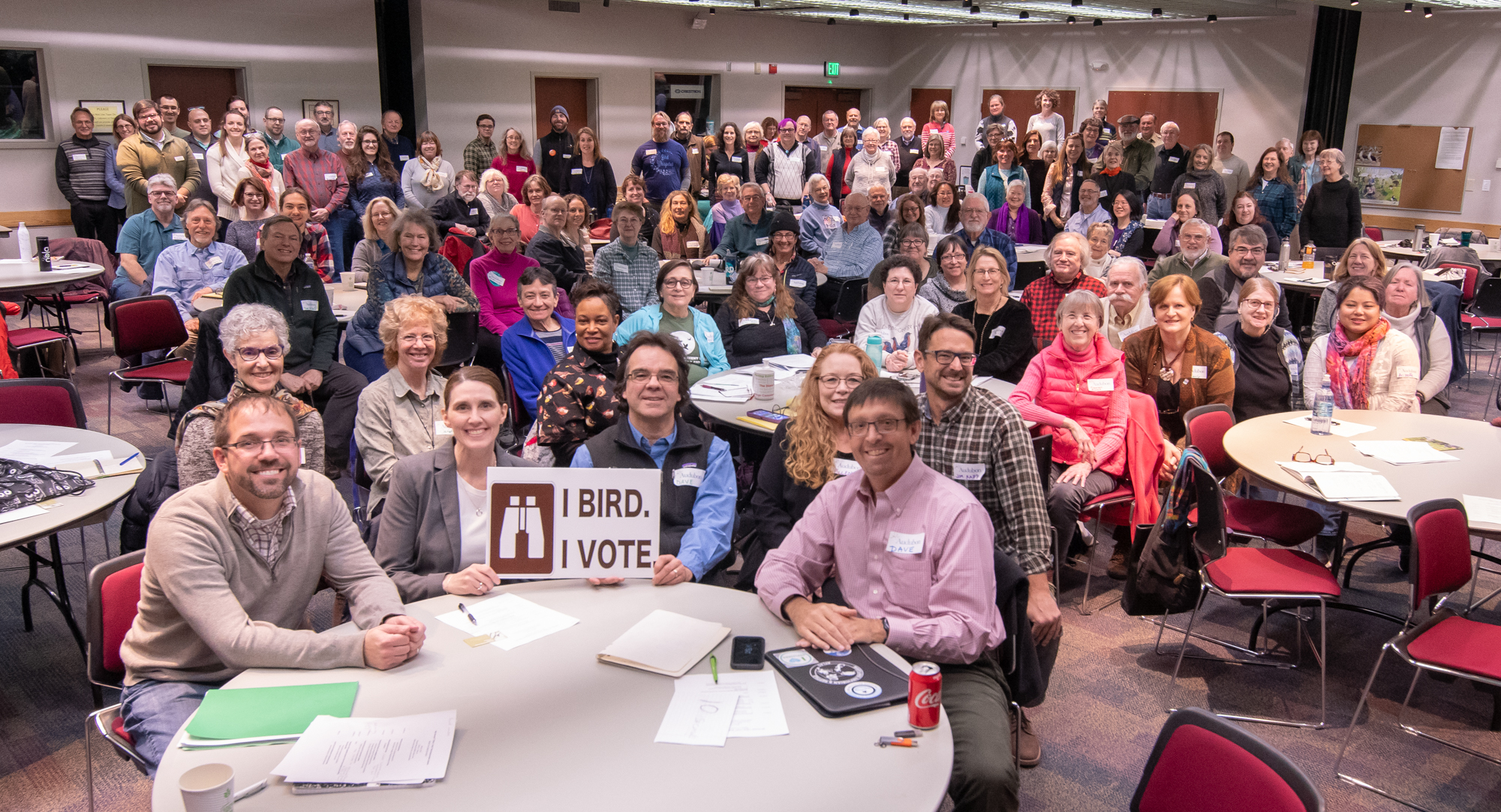
| Thanks to all who responded to our urgent requests for support on numerous bills during this legislative session! |
This was a good year for the environment in the Maryland legislature except for the loss of Maryland House Speaker Michael Busch, a true environmental champion. We will always remember him as a bona fide advocate for birds, wildlife, and clean water.
Thanks to all of you who responded to our urgent requests for support on numerous bills, Audubon Maryland-DC, along with partners at the League of Conservation Voters, Chesapeake Bay Foundation, Preservation Maryland, Safe Skies Maryland, Maryland Ornithological Society and others were able to advance significant bird-friendly legislation.
The following Audubon Maryland-DC-supported bills PASSED and await the governor’s signature:
The Polystyrene ban, (SB0285/HB0109) is the first of its kind in the nation! It bans the use of most foam containers in Maryland and will help save the lives of everything from seabirds to sea turtles.
The State and Local Forest Conservation Funds, (SB0234/HB0272) will require both developers and state and local governments to restore forest rather than letting funds sit in inadequate unspent pots of money. This will ultimately force local governments to re-plant forests as intended by the original act.
The Technical Study on Changes in Forest Cover and Tree Canopy (SB0729/HB0735), formerly Task Force on Forest Conservation, sets up a technical review of existing forest cover in the state and an analysis of the health and quality of state forests. Much of the state-managed land is currently managed for biologically impoverished pine plantations. We hope this task force ultimately improves forest management and quality.
The Clean Energy Jobs Act (SB0516/HB1158) establishes criteria for qualified offshore wind projects, altering and extending the minimum required percentage of energy that must be derived from renewable sources in the State's renewable energy portfolio standard. This is an important step in helping Maryland kick the greenhouse gas habit and growing the renewable jobs sector.
These Audubon Maryland-DC-supported bills FAILED but in most cases made progress and will be re-submitted in 2020:
The Maryland Sustainable Buildings Act, (SB0314/HB0136), (formerly Bird Safe Buildings) would have required the state to establish standards for state-funded projects and State of Maryland buildings to minimize impacts on birds. Thousands of nighttime migrating birds are killed every year in Maryland from window strikes. The bill passed both chambers but ran out of time to be reconciled.
The Chlorpyrifos ban, (SB0270/HB0275) would have banned the sale of this bird- and insect-killing chemical in Maryland. In 2017, the Trump administration’s Environmental Protection Agency (EPA) took the unprecedented action of overturning its own proposed ban on chlorpyrifos. The state of Maryland had the opportunity to at least protect its own citizens and wildlife. The bill passed through the House of Delegates, but despite being voted out of the Senate Committee, it died for lack of interest by Senate leadership.
The No Net Loss of Forest bill (SB0203/HB0120) would have changed the state standard for achieving a no net loss of forest policy by altering the definition of “forest” to refer to real forests rather than street and ballpark trees. This would have ensured mitigation was achieved through restoration of bona fide forests. The Hogan administration lobbied against the bill saying enforcement would be too expensive. For this reason, it never made it out of the House despite passing in the Senate.
The Healthy Climate Initiative (HB1235/SB0702) would have made polluters and greenhouse gas emitters pay a steadily rising fee for emitting carbon pollution. It would have incentivized clean energy by imposing new state charges on greenhouse gas-emitting energy suppliers. Legislators deemed this too expensive. |
|
|
|
|